
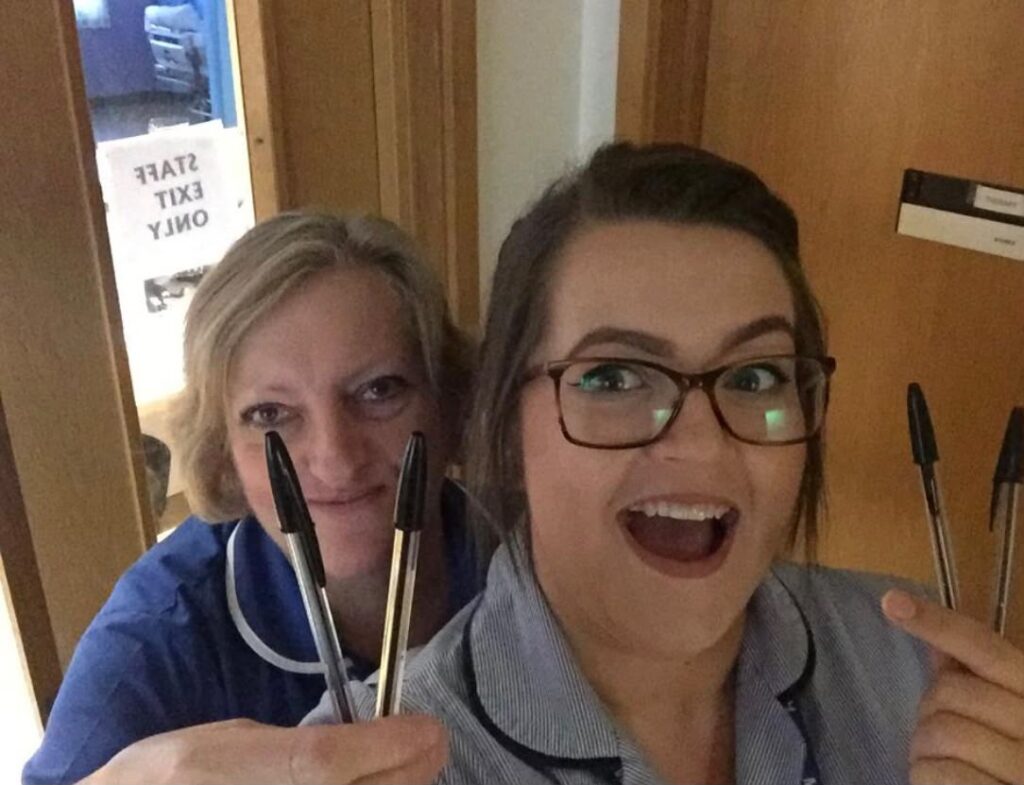
 Chloe is a Lead Nurse in our In-Patient Unit and has worked at the Hospice for four years. In 2023 her former nursing colleague and close friend Debbie was admitted to the unit for end-of-life care.
Chloe explains how it felt to experience the other side of our care, and how she found a balance between being a hospice nurse and being a friend.
Pictured: Debbie (left) and Chloe
When I was a newly qualified nurse working on one of the wards at Milton Keynes University Hospital, Debbie was the ward sister in charge. She’d been a healthcare assistant for years, then did her nursing training. She was a character, shall we say!
We got on from when we first met, and remained close friends after I left. She was a dedicated nurse and never retired.
“As her friendship group, we knew … we’d be there for her.”

A friend’s promise
When they diagnosed Debbie, she was already very poorly. She had cervical cancer, but it had spread to her bowel, so she had a stoma as well. As her friendship group, we knew that if there wasn’t any curative treatment, we’d be there for her.
Debbie rang me when she got diagnosed and said, “If I die from this, will you look after me at Willen?” I couldn’t promise this, because we have criteria for which patients we can accept at the Hospice, but I did promise that I would look after her as a friend.
Understanding boundaries
Debbie came to Willen eventually and stayed in the In-Patient Unit for a night and a day. As nurses, we have to declare a conflict of interest when a close relative is being cared for by the Hospice. The way I decide whether it’s appropriate for me to care for someone or not is to think about a specific situation. If my loved one was ringing the call bell in their room and another patient was ringing it at the same time, would I feel like I wanted to go to my loved one first? If I would, then it’s too close of a relation and it’s too much of a conflict of interest. That was the case with Debbie.
“I couldn’t think of Debbie as a patient… You lose that insight when it’s someone so close to you.”
I had to be really clear on where my boundaries were. I’d spoken to my line manager and they said, “As soon as Debbie arrives, you go home, get changed, come back without your uniform on and you’re just here as a friend.” Our uniform does make us feel different. It was tough though, because even without my uniform on, I couldn’t forget all the knowledge I’ve got. But I also couldn’t think of Debbie as a patient, from a professional point of view. You lose that insight when it’s someone so close to you.
Peaceful death
Debbie died in her own way. Everybody had gone home, and it was just me and her sister with her. As soon as we sat down to settle for the night, that’s when Debbie took her last breath.
“Her hand was still holding on to the teddy I’d bought her.”
She went from stable breathing to peacefully dying with us both by her side. Her hand was still holding on to the teddy I’d bought her.

Seeing things differently
For me it was such a special experience to see what it’s really like being a patient’s loved one. All of the In-Patient Unit team were just so supportive in helping me get that balance right. Because they could have felt a little bit awkward about it. But I never felt that. They made me feel comfortable enough that I could go to sleep in Debbie’s room and they would come in and reposition her. They let me be ‘friend Chloe’, rather than ‘nurse Chloe’, which was a huge thing.
“They let me be ‘friend Chloe’, rather than ‘nurse Chloe’.”
I did see everything very differently. I felt I didn’t want to be ringing the call bell too often, even though when I’m working I tell relatives to ring it as many times as they want! I also noticed how much the different patients’ relatives support each other, particularly in the Lakeview Room and other common spaces. You can see how much conversation goes on in those rooms. Some of them exchange numbers. You often want someone to talk to, especially when you’re there all night.
Overnight support
I stayed overnight with Debbie in her room. I felt comfortable because I knew that if I needed to have a little cry or a midnight snack and a cup of tea, there were nurses at the end of the corridor who I knew. They would sit with any of the relatives and do that.
That’s the environment we try to create on the unit for anyone who’s staying over: if you can’t sleep, or you want a cup of tea in the middle of night, just press the call bell. The bell is for loved ones as well as patients. Because it can be so isolating when you’re just watching somebody and you know they could die at any moment.
“…you’re seeing things happen that you’ve just gone through yourself.”
Compassionate working environment
Everybody at work was so sensitive afterwards. They suggested I didn’t come to the morning meeting where we discuss the deaths that have happened during that week. They put Debbie’s flowers out on the reception desk, which was nice for me to see.
Just having some awareness, because all of us can go through bereavement. But in this line of work, you can’t distract yourself from it. You walk in and you’re seeing things happen that you’ve just gone through yourself.
“Even though we’re hospice nurses, we can still be parents, children, partners…”
Only human
When people find out you work in a hospice, they think you’re an expert at handling everything that comes with death. We do build up some resilience, of course. But that resilience is very different when it’s your own family and your own friends.
It’s important for us to remember that even though we’re hospice nurses, we can still be parents, children, partners, siblings and friends at the same time.


